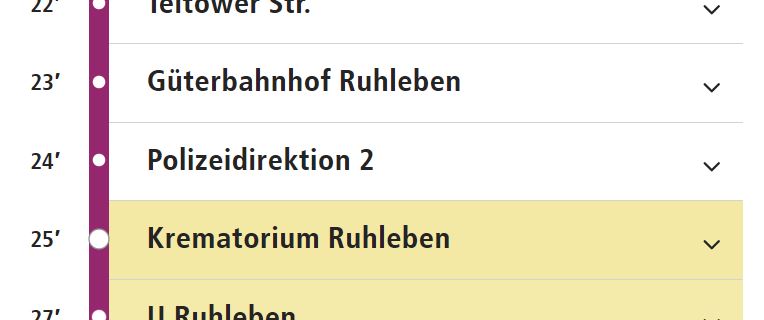
Die Streckenführung der Buslinie M45 in Berlin, die vom Güterbahnhof Ruhleben zur Polizeidirektion 2 und anschließend zum Krematorium führt, ist schon ein bisschen makaber, oder?
Zumindest bei historisch sensiblen Fahrgästen läuten da die Alarmglocken.
Ansonsten ist der wirklich ruhige Bahnhof Ruhleben auch der Ausgangspunkt für die Busse nach Falkensee, wo Ihr in den zweiten Teil des Spandauer Wegs einsteigen könnt.
I am a lawyer in Germany, with a focus on international family law, migration and citizenship law, as well as constitutional law.
My other interests include long walks, train rides, hitchhiking, history, and writing stories.
The only other associations that I have with the German word „Spandau“ are reading somewhere in my youth that Rudolf Hess died in a prison there and then later a pop singing group that called itself „Spandau Ballet“ who had a hit song that I always liked called „True.“ https://youtu.be/AR8D2yqgQ1U?si=rQVhHEdbFBN60NTb
Upon researching further, Spandau Ballet so called themselves because friend of the band had visited Berlin and Spandau Prison and imagined old Rudolf Hess, the only prisoner there, alone in his cell „doing a Spandau ballet.“ The irony of an ancient Nazi war criminal who would soon hang himself in his cell inspiring a 1980s British New Wave band is just too wonderful, isn’t it? https://youtu.be/JE2sCISQmpE?si=TME6BzRi4AhCPxd1
They have a huge fortress there in the middle of the city: https://www.zitadelle-berlin.de/en/fortress/ , so I naturally thought that this was the prison for the Nazi criminals.
Turns out that it wasn’t and that after Rudolf Hess, the last prisoner, had died, the British authorities destroyed and flattened the prison in 1987.
They wanted to prevent it from becoming a pilgrimage site for neo-Nazis, and to that purpose even shredded all the debris and spread it in the North Sea.
The plan didn’t quite work, because the British authorities had handed over the dead body to Hess‘ family. So the neo-Nazis simply chose the cemetery in Wunsiedel as their new pilgrimage site.
Finally, in 2011, the family put an end to this by having the remains cremated and distributed in the North Sea, giving up the grave at the cemetery.
I wonder what the North Sea would say about all that crap being thrown into its waters.


 Der reisende Reporter
The only other associations that I have with the German word „Spandau“ are reading somewhere in my youth that Rudolf Hess died in a prison there and then later a pop singing group that called itself „Spandau Ballet“ who had a hit song that I always liked called „True.“ https://youtu.be/AR8D2yqgQ1U?si=rQVhHEdbFBN60NTb
Upon researching further, Spandau Ballet so called themselves because friend of the band had visited Berlin and Spandau Prison and imagined old Rudolf Hess, the only prisoner there, alone in his cell „doing a Spandau ballet.“ The irony of an ancient Nazi war criminal who would soon hang himself in his cell inspiring a 1980s British New Wave band is just too wonderful, isn’t it? https://youtu.be/JE2sCISQmpE?si=TME6BzRi4AhCPxd1
They have a huge fortress there in the middle of the city: https://www.zitadelle-berlin.de/en/fortress/ , so I naturally thought that this was the prison for the Nazi criminals.
Turns out that it wasn’t and that after Rudolf Hess, the last prisoner, had died, the British authorities destroyed and flattened the prison in 1987.
They wanted to prevent it from becoming a pilgrimage site for neo-Nazis, and to that purpose even shredded all the debris and spread it in the North Sea.
The plan didn’t quite work, because the British authorities had handed over the dead body to Hess‘ family. So the neo-Nazis simply chose the cemetery in Wunsiedel as their new pilgrimage site.
Finally, in 2011, the family put an end to this by having the remains cremated and distributed in the North Sea, giving up the grave at the cemetery.
I wonder what the North Sea would say about all that crap being thrown into its waters.
Would that the world could have dumped all the Nazis into the North Sea in 1923.
Indeed! 😀